Bird Notes from a Cottage Above the Majestic Ganga River
Experience the birdlife of Rishikesh through a personal account of five Himalayan foothill species seen around a riverside resort overlooking the Ganga. From Himalayan Bulbuls on the cottage verandah to White-capped Redstarts on the river’s edge, this article explores the common birds of the Shivalik range.
BLOG_ARTICLES
Rajiv Soni
12/11/20256 min read
Early December in the Shivalik foothills has a character entirely its own. The mornings arrive pale and cold, with a faint mist clinging to the slopes, as though reluctant to leave. The sun, slow to warm the valley, throws long shadows over the emerald waters of the Ganga, and every leaf seems dipped in silver. It is a time when birdlife becomes particularly animated — migrants descend from higher elevations, residents grow restless with the mild winter, and the river becomes a corridor of movement and song.
During a recent stay at a resort near Rishikesh, perched gently between the Karanprayag–Haridwar road and the broad, serene sweep of the Ganga, I found myself surrounded by nature’s theatre. My cottage stood on the upper tier of a slope arranged in terraces — the badminton court on one, the cafeteria on another, and several cottages scattered like shy participants in a hillside festival. From my verandah, I could watch the river glide past in its muted green dignity while the Shivalik range rose sharply across the bank, dotted with a few distant villages that clung like white beads on the shoulders of the mountains.
It was from this verandah, and in the small excursions that followed, that I renewed my friendship with some familiar birds of the Himalayan foothills.
The Himalayan Bulbul — Herald of the Winter Morning
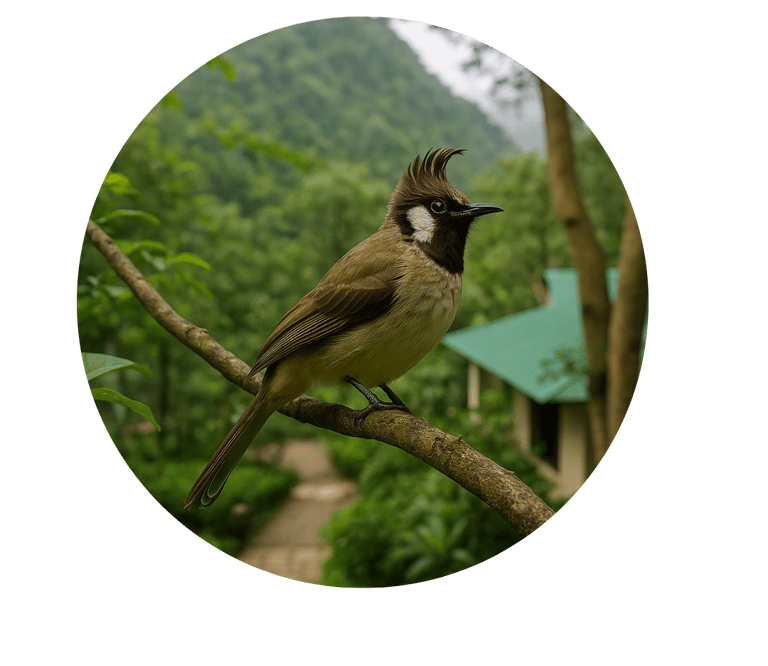
On my first morning, as the gentle sun attempted to warm the verandah, a crisp, musical whistle announced my first visitor: the Himalayan Bulbul. With its bold white cheek patch and that unmistakable forward-curled crest, it hopped confidently along a branch near the badminton court, surveying the scene like a seasoned headmaster monitoring school assembly.
Unlike its city-dwelling cousin, the Red-vented Bulbul, this mountain bird carries itself with a certain finesse, as if shaped by the clear air and the quiet dignity of the hills. Early winters suit them – they become conspicuous, busy in small foraging parties among the flowering shrubs around the resort. Their bright yellow undertail flashes like streaks of sunlight whenever they dart across the terraces.
Along the Mango Trail — The Playful Plum-headed Parakeets
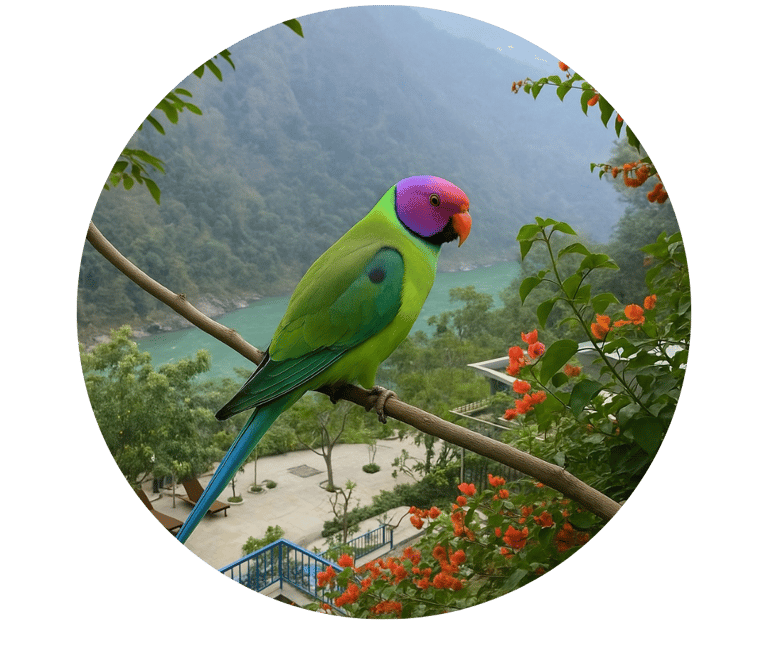
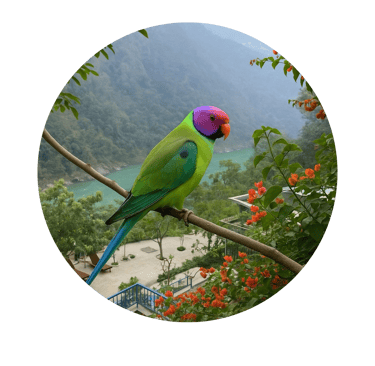
Behind the resort rose a narrow path, known affectionately as the Mango Trail, winding through old mango trees and lantana thickets. As I ventured up this path in the soft, cool light of the forenoon, a flurry of emerald wings cut across my line of sight. A small flock of Plum-headed Parakeets descended upon a fruiting branch, each bird as beautifully brushed as a miniature painting.
The males, with their exquisite plum-coloured heads, looked almost regal. The females, dressed in gentler greens, chattered endlessly, nibbling at tender mango leaves. These parakeets show none of the boldness of their Rose-ringed cousins from the plains; instead, they carry the quiet mischief of forest dwellers, watching hikers with faint amusement.
Their presence is a reminder that the Shivalik forests, even near bustling routes like the Karanprayag–Haridwar road, are teeming with species that thrive in pockets of undisturbed habitat.
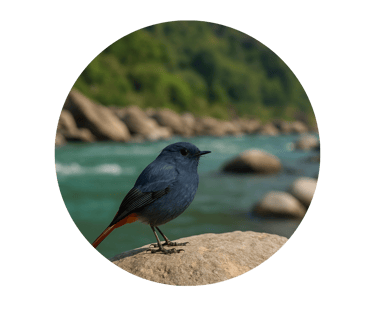
The White-capped Redstart — Jewel of the Ganga’s Edge
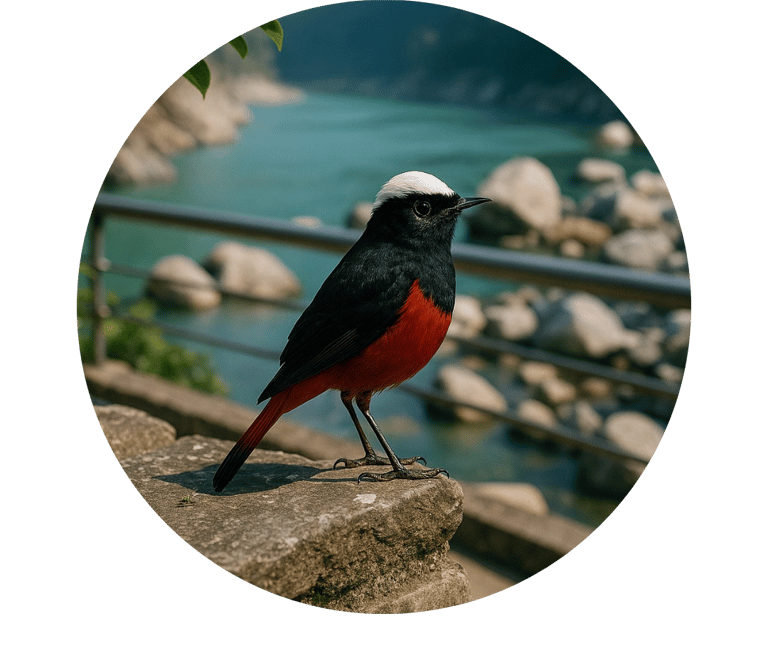
In the afternoon, I wandered down to the resort’s small sandy beach by the Ganga. The river, in early December, flows with a serene slowness — its surface jade-green, its currents cold enough to sting the fingers. There, among the boulders slick with mist and river spray, appeared a bird that seems carved from contrast itself: the White-capped Redstart.
Sitting upright on a smooth grey stone, its gleaming white crown, glossy black plumage, and rust-red tail caught the sun as it flicked insects off the water’s surface. No riverine landscape in the Himalayas is complete without this bold little guardian. Unlike many other birds, it appears almost indifferent to human presence, hopping confidently from rock to rock as rafters glide past and the river breathes in its ancient rhythm.
I spent a good while watching its spirited movements — a perfect embodiment of the river’s restless soul.
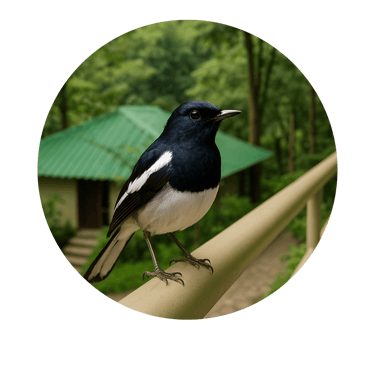
The Oriental Magpie Robin — Evening Singer of the Patio
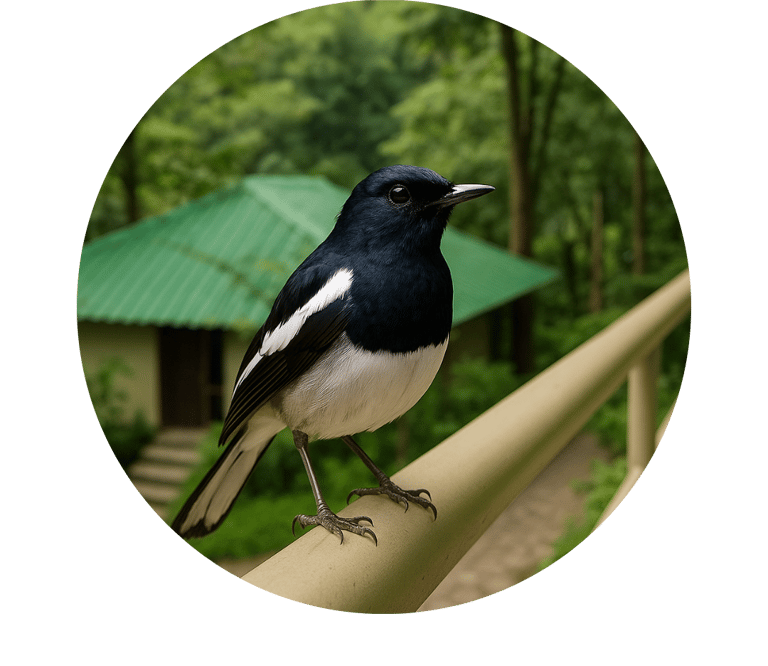
When dusk approached and the valley grew quiet under a cooling sky, I took my tea on the resort’s patio. The stillness was punctuated suddenly by a clear, melodious sequence of phrases — the unmistakable Oriental Magpie Robin.
Dressed in its immaculate black-and-white suit, the bird perched on the railing near the cafeteria terrace and launched into a recital worthy of an evening raga. In winter, with fewer insects to chase, this species devotes extra time to singing, broadcasting its presence across the valley.
Its song echoed gently against the forest wall behind the resort, filling the patio with the unmistakable warmth of a familiar friend.
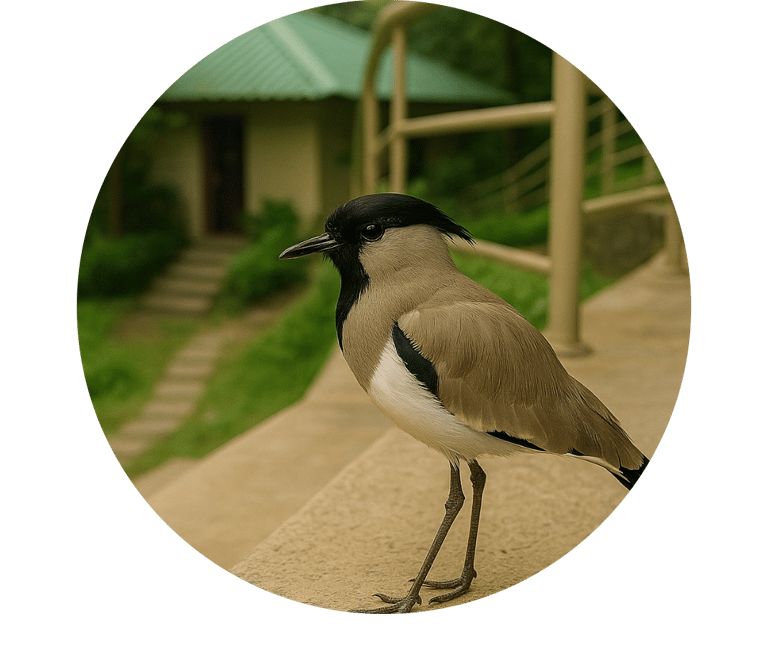
The River Lapwing — Sentinel of the Winter Shoreline
Just before dusk melted into evening, I walked again to the riverbank. The fading light painted the Ganga in dull gold, and on the sandy margin strutted a bird of great dignity — the River Lapwing.
With its black cap, pale grey wings, and long, deliberate stride, the Lapwing carried the air of a solitary fisherman inspecting his territory. Its sharp call pierced the evening quiet whenever someone wandered too close. Unlike the noisy Red-wattled Lapwing of the plains, this species prefers understatement and discipline — it is a watchman of the river, calm and composed.
Watching it wade delicately along the shore felt like a benediction at the end of the day.
The Valley’s Other Avian Characters, No Less Fascinating:
The Shivalik range is an ecological crossroads — where Himalayan species descend in winter and plains species ascend in search of fruiting trees. During this season, a patient observer along the riverbanks, forest trails, and cliff faces can encounter a remarkable diversity.
From your file of local species, several deserve mention here :
Plumbeous Water Redstart
A constant companion of fast-flowing streams, the Plumbeous Redstart is almost guaranteed along rocky stretches of the Ganga. The male, with his slate-blue coat and fiery tail, is a favourite among photographers.
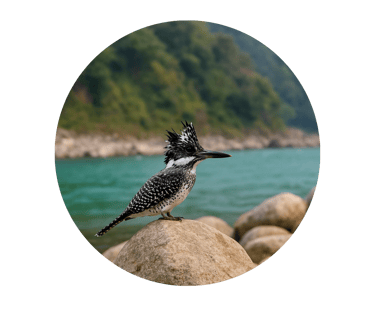
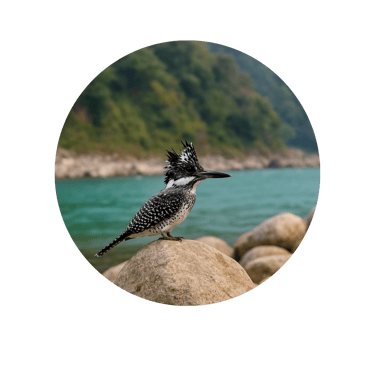
Crested Kingfisher
One of the most impressive kingfishers in India, this large black-and-white speckled bird prefers perching above wide rivers. Its sudden, powerful dives into the water are unforgettable.
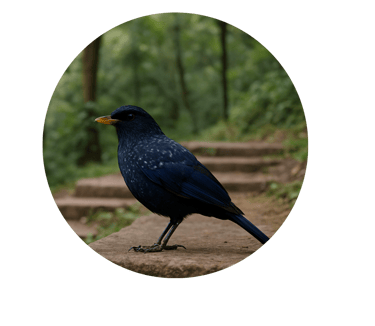
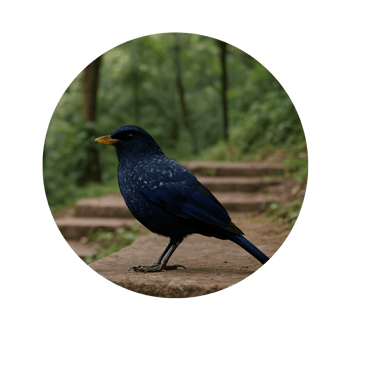
Blue Whistling Thrush
Often encountered at dawn, especially near forest-clearings, this deep-blue bird’s fluty, human-like whistle can be hauntingly beautiful.
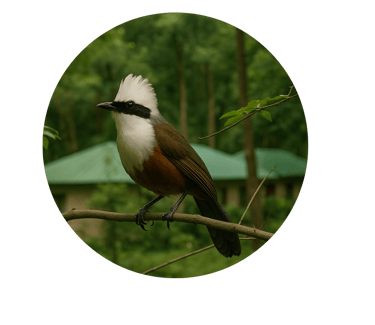
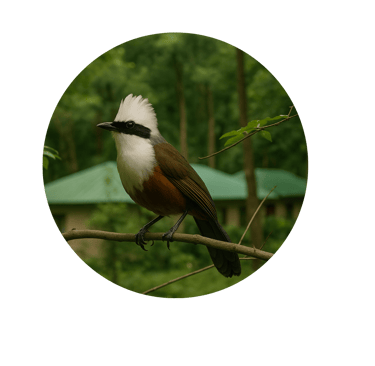
White-crested Laughingthrush
Moving in chattering bands, these masked birds bring a sense of commotion wherever they go. Their loud, laughing calls echo across the hillsides.
Barbets and Hornbills
In the slightly denser forest patches one may encounter Lineated Barbets, Blue-throated Barbets, and occasionally the magnificent Great Hornbill, whose wingbeats sound like the rhythmic thumping of a helicopter.
A Closing Reflection
Early winter in the Himalayan foothills is a season of quiet splendour. The trees hold their breath, the river slows her song, and the birds — both resident and wandering — weave a subtle narrative across the landscape. As I sat on my verandah overlooking the terraces, the Ganga, and the Shivalik hills rising beyond, I could not help but feel that this valley, briefly, lets the natural world come a little closer.
In such moments, one understands what old birdwatchers often say: a journey in the Himalayas is never measured in miles, but in the birds you meet along the way.

Discover about Mumbai's vibrant birdlife and the conservation efforts by nature lovers.
© 2025. All rights reserved.